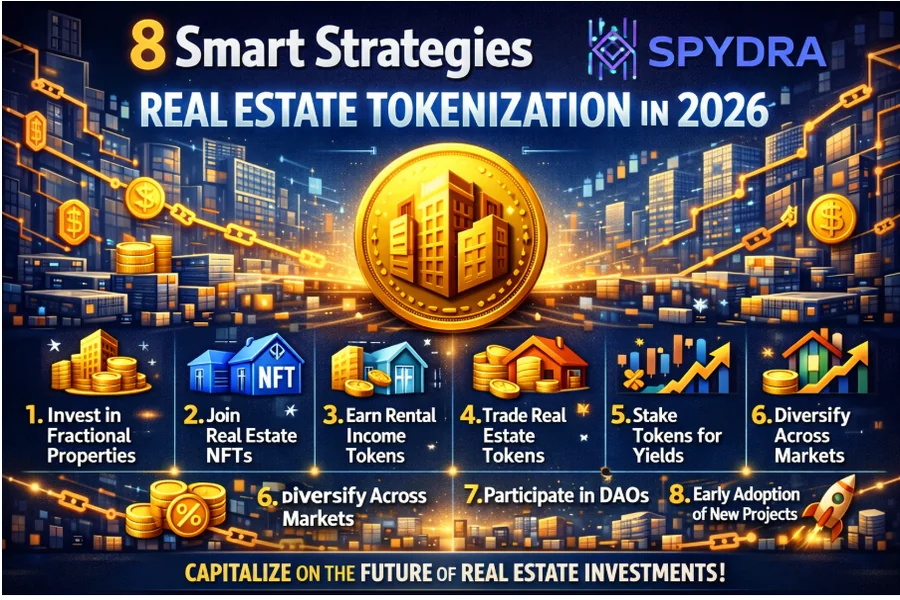
8 Smart Strategies to Profit from Real Estate Tokenization in 2026
Real estate has always been a cornerstone of wealth creation—but it’s also been slow, capital-intensive, and illiquid. For decades, investors needed large upfront capital, long holding periods, and complex legal structures just to participate.
Now ask yourself: What if you could invest in premium real estate assets with the flexibility of stocks?
That’s exactly what Real Estate Tokenization unlocks.
If you’ve been wondering what is asset tokenization, it’s the breakthrough transforming real estate into a liquid, borderless, and highly accessible asset class. And in 2026, this shift isn’t theoretical—it’s actively creating profit opportunities for early adopters.
Let’s break down how you can capitalize on it.
What is Asset Tokenization?
Before diving into strategies, it’s critical to understand the foundation.
Simple Definition
What is Asset Tokenization? It’s the process of converting ownership rights of a real-world asset—like real estate—into digital tokens on a blockchain.
Each token represents a fractional share of the asset, allowing investors to buy, sell, and trade ownership seamlessly.
How Asset Tokenization Works
- Asset Structuring
A property is legally structured (often via SPVs or trusts) to enable fractional ownership. - Tokenization Process
The asset is digitized into blockchain-based tokens representing ownership shares. - Distribution & Trading
Investors purchase tokens via compliant platforms and can trade them in secondary markets.
Real-World Example
Consider a $5 million office building:
- Divided into 500,000 tokens
- Each token = $10 ownership
- Investors globally can participate
Instead of needing millions, investors can now enter with minimal capital—this is the power of Real Estate Tokenization.
Why Real Estate Tokenization is Exploding in 2026
This isn’t just a trend—it’s a structural shift in how assets are owned and traded.
Key Growth Drivers
Institutional Momentum
Large asset managers are increasingly exploring tokenized real estate to improve liquidity and efficiency.
Demand for Liquidity
Traditional real estate locks capital for years. Tokenization enables faster entry and exit.
Global Investor Access
Cross-border participation is easier through blockchain real estate platforms.
Technology Maturity
Infrastructure around digital asset tokenization is now enterprise-ready and scalable.
8 Smart Strategies to Profit from Real Estate Tokenization in 2026
1. Unlock Liquidity Arbitrage Opportunities
What it is:
Buying undervalued tokenized assets and selling when liquidity increases.
Why it works in 2026:
Markets are still inefficient, creating pricing gaps.
Example:
Buying early-stage tokens before institutional demand increases.
Pro Tip:
Focus on assets entering secondary markets.
2. Maximize Returns with Fractional Diversification
What it is:
Spreading capital across multiple properties.
Why it works now:
Fractional real estate investing reduces risk exposure.
Example:
Investing across residential, commercial, and rental tokens.
Pro Tip:
Diversify across geographies.
3. Earn Passive Income Through Tokenized Rentals
What it is:
Earning rental yield via token ownership.
Why it works in 2026:
Smart contracts automate payouts.
Example:
Holding tokens in rental-generating properties.
Pro Tip:
Prioritize high-occupancy assets.
4. Capitalize on Early-Stage Token Launches
What it is:
Investing at initial token issuance.
Why it works now:
Early investors gain discounted access.
Example:
Participating before public listing.
Pro Tip:
Evaluate compliance and legal structure carefully.
5. Trade Tokenized Assets for Short-Term Gains
What it is:
Actively trading real estate tokens.
Why it works in 2026:
Secondary markets are gaining liquidity.
Example:
Buying during dips, selling during demand spikes.
Pro Tip:
Track macroeconomic trends.
6. Leverage Global Market Access
What it is:
Investing internationally without physical presence.
Why it works now:
Blockchain real estate platforms remove geographic barriers.
Example:
Owning fractional shares in overseas properties.
Pro Tip:
Target high-growth cities.
7. Invest in High-Yield Alternative Assets
What it is:
Targeting niche segments like logistics or co-living.
Why it works in 2026:
Tokenization unlocks new asset classes.
Example:
Investing in warehouse properties driven by e-commerce.
Pro Tip:
Follow demand-driven sectors.
8. Future-Proof Your Portfolio with Digital Assets
What it is:
Allocating to digital asset tokenization long-term.
Why it works now:
Blockchain adoption is accelerating.
Example:
Building a hybrid portfolio.
Pro Tip:
Start small and scale gradually.
Benefits of Real Estate Tokenization
- Liquidity – Easier buying and selling
- Accessibility – Lower capital requirements
- Transparency – Blockchain-based verification
- Faster Transactions – Reduced intermediaries
- Global Reach – Borderless investing
Risks Smart Investors Shouldn’t Ignore
Key Risks
- Regulatory Uncertainty
- Market Volatility
- Technology Risks
Mitigation Tips
- Use compliant platforms
- Diversify investments
- Conduct proper due diligence
How Platforms Like Spydra Enable Real Estate Tokenization
Platforms like Spydra simplify and accelerate adoption.
Key Capabilities
- End-to-end tokenization
- Compliance-ready frameworks
- Enterprise-grade security
- Scalable infrastructure
This allows businesses to launch faster and operate securely in the tokenized real estate ecosystem.
The Future of Real Estate Tokenization in 2026 and Beyond
We’re still early in the transformation.
What’s Ahead
- Institutional capital inflow
- Regulatory clarity
- Liquid secondary markets
- DeFi integration
Early adopters stand to gain the most.
Conclusion: The Time to Act is Now
Real Estate Tokenization is redefining how wealth is created.
It offers:
- Lower barriers
- Higher flexibility
- New revenue opportunities
So here’s the real question:
Will you wait—or will you take advantage early?
Explore how tokenization can transform your real estate strategy today.
