Why Shooters Customize Their Rifles: The Psychology Behind Rifle Upgrades
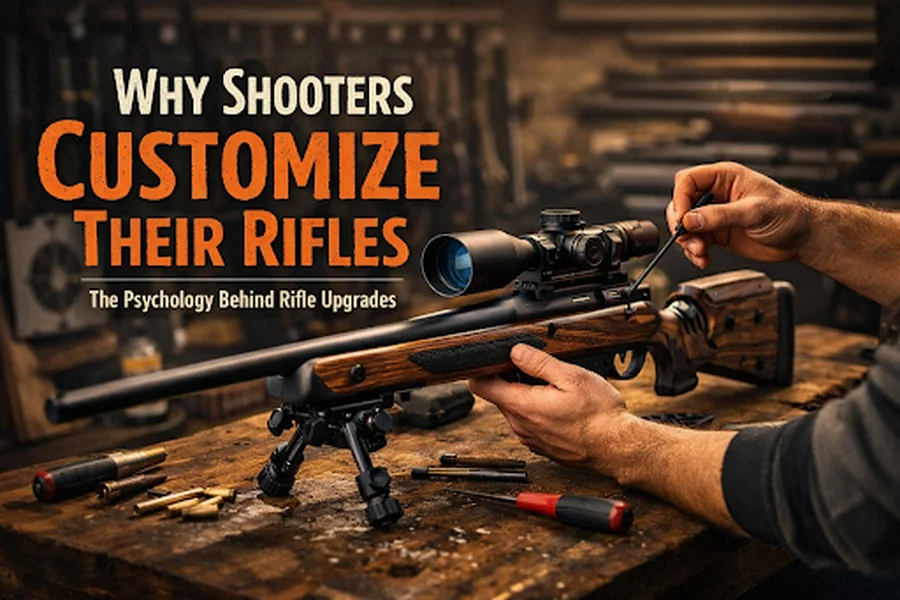
There’s a moment most shooters hit sooner or later. It’s not dramatic. It’s usually boring, actually. You’ve got a rifle that’s perfectly “fine.” It groups well enough. It goes bang every time. You’ve carried it a few times, shot it off a bench, maybe leaned it against a tree while you glassed a ridge. Nothing is wrong.
But one day you shoulder it and think: Why does this feel slightly… off?
Not broken. Not unusable. Just off.
That’s when customization starts. Not because someone wants to play gunsmith. Not because they’re trying to win the internet. It starts because the rifle begins to feel like a pair of boots that technically fits — but rubs your heel in exactly the same spot every time.
And once you notice it, you can’t un-notice it.
The first upgrade usually isn’t about “accuracy.” It’s about comfort you can trust.
People love to say they upgrade for accuracy. Sometimes that’s true. But in real life, the most common motivation is simpler: the rifle doesn’t feel consistent in you.
You can have a great action and a good barrel, but if your face doesn’t land in the same place on the stock every time, you end up doing that little micro-adjustment dance behind the scope. Nudge the cheek. Roll the head. Move the shoulder a hair. It’s subtle, but it’s real — and it’s exhausting when you’re trying to shoot well.
That’s why “stock upgrade” becomes such a common rabbit hole. It’s not a glamorous part. It’s not even the part people want to spend money on. But it’s the part that changes how the rifle meets your body.
If someone’s browsing options, they usually start broad — collections that are clearly built around hunting use, not competition-only ergonomics — like this hunting stock/chassis lineup on WOOX. It’s not a sales pitch to say that; it’s just where people begin when they’re trying to figure out what “fits better” even means in the real world.
“Worth it?” is the question that gives away what’s really going on.
The phrase you’ll hear more than anything in forums and at ranges is: Is it worth it?
And that question usually isn’t about money. Not only, anyway.
It’s about doubt.
Shooters upgrade when they’re tired of second-guessing the setup. When they don’t want to wonder whether the miss came from their technique or the way the rifle sits. When they want a system that behaves the same on a bench, kneeling in gravel, and leaning into a tree at a weird angle.
That’s the psychology in a nutshell: upgrades are often an attempt to buy back certainty.
Not certainty that you’ll make every shot — no adult believes that — but certainty that the rifle isn’t adding problems you didn’t ask for.
The chassis vs stock debate is basically a personality test.
Ask ten shooters “stock or chassis?” and you’ll get twelve opinions, because the answer isn’t purely technical. It’s preference, environment, and identity all tangled together.
Some shooters want adjustability and a “dialed” feel. They like settings they can change: comb height, length of pull, grip style. They want the rifle to feel set up for them, not for “average.” That’s the world precision-style stocks and chassis live in, and if you’re showing examples without sounding like an ad, a collection page like this does the job.
Other shooters want something that feels familiar. Warmer in the cold. Less “metal bench gun,” more “rifle you don’t think about while hiking.” They’ll trade some adjustability for feel. And honestly? That’s not irrational. That’s a hunter making a comfort decision.
It’s not tradition vs performance. It’s comfort vs control — and most people are trying to land somewhere in the middle.
Customization is also an attachment thing. You build it, so you love it.
Here’s the part people don’t always admit: customizing is satisfying.
Not because it makes you superior — because it makes the rifle yours.
Choosing parts, fitting the rifle to your body, making small decisions that add up… it creates attachment. The rifle becomes less like a product and more like a project. And once you’ve invested attention into something, you care about it differently.
That’s why tools that let people configure their setup are so sticky. Even if someone doesn’t buy immediately, they’ll spend time “building” in their head. If you’re writing editorial-style and want a natural reference point for that behavior, this “build your stock” page fits the psychology angle cleanly.
It’s not “buy this now.” It’s “people like to shape things.”
A single example is enough (and it makes the writing sound real).
If you’re going to mention a specific product, do it once, casually, like you would in a conversation — not like you’re trying to convert.
Something like: there are stocks out there that try to keep the classic wood look while still behaving like a modern setup. The Merica Precision Stock is a straightforward example of that “heritage feel + modern function” idea, which is why it’s easy to reference without turning the article into a catalo.
One mention. Move on. That’s how humans write.
The long-range trend is leaking into hunting (even for people who “don’t do long range”).
Another reason customization is booming is that hunting rifles have quietly borrowed habits from the precision world. Better glass. Better mounts. More attention to stable positions. More people practicing from awkward rests instead of only shooting off a bench.
Even if someone isn’t taking 600-yard shots, they still want the rifle to settle and track better — and that pushes them toward more stable stock designs.
So why do shooters upgrade?
Most of the time it’s one of these:
They want the rifle to fit without fighting it.
They want the setup to feel repeatable.
They want to remove one more variable from the shot.
And, yes — they want to feel proud of what they’re carrying.
None of that is shallow. It’s what people do with the things they care about.
A rifle starts as a factory object. Over time, if someone sticks with it, it becomes a personal one. Customization is just the visible proof of that relationship.
